Our Drone Blog
WHAT PRODUCTS DO WE USE IN OUR DRONE TREATMENTS?
By: Benjamin P. Hays, UAV Coordinator
September 9, 2026
What Products Do We Use in Our Treatment Drones?
We use three different products in our treatment drones, and we only conduct aerial treatments during daylight hours. We don’t “spray” from our drones. Instead, we use granular larvicide products to treat wetlands and other mosquito-breeding areas, including thickly wooded areas throughout the county.
Many people have asked what products we use in our treatment drones, so let’s break them down.
Altosid® P35
The first product we’ll discuss is one of our personal favorites: Altosid® P35, created by Central Life Sciences.
P35 is a granular larvicide that provides up to 35 days of residual control in continuously wet conditions. It uses extended-release technology and can also be used for pre-treatment. As an insect growth regulator, P35 is activated when it becomes wet and works by interrupting mosquito development and preventing adult emergence.
Our application rate for P35 is 10 pounds per acre.


Duplex-G®
The second product we use is Duplex-G®, also created by Central Life Sciences.
Duplex-G is a biological mosquito control product containing the active ingredient Bacillus thuringiensis subspecies israelensis (Bti) in a granular formulation. It provides rapid control of mosquito larvae while offering residual control of many mosquito species.

Its high bulk density helps the granules penetrate vegetation effectively, making it well suited for aerial applications. The formulation is designed to provide targeted mosquito control while minimizing impacts on non-target organisms and supporting environmental compatibility.
Our application rate for Duplex-G is 10 pounds per acre.

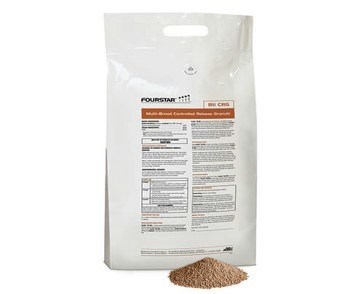
FourStar® Bti CRG
The third and final product we use in our treatment drones is FourStar® Bti CRG, another Bti-based larvicide created by Central Life Sciences.
This controlled-release granule primarily targets Aedes taeniorhynchus and provides up to 40 days of larval control. It is a high-density, sand-based granular larvicide designed for use in both saltwater and freshwater habitats, including areas beneath dense vegetation.

Its weight and granular formulation allow for effective penetration through vegetation and help minimize off-target movement, providing efficient coverage during aerial applications.
Our application rate for FourStar Bti is 10 pounds per acre.
Why We Use Granular Products
One question we receive frequently is whether we conduct liquid aerial applications. We do not.
We evaluated the advantages and disadvantages of liquid aerial applications and determined that they are not an effective method for controlling mosquitoes from the air under our operating conditions.
Our drone applications are limited to granular products specifically selected for aerial mosquito larval control. The only liquid applications conducted by S. Walton Mosquito District are performed from the ground.
Our goal is to use effective, targeted products and application methods to manage mosquito populations while being mindful of the surrounding environment.
For more info about our products, visit our Products page of our website. _____________________________________________________________________________________________________________
DRONE TECHNOLOGY IN MOSQUITO CONTROL
By: Benjamin P. Hays, UAV Coordinator
April 20, 2026
The use of drones is not just a trend—it is the future of mosquito control. As technology advances, drones now offer longer battery life, higher payload capacities, and improved imaging systems. In some parts of the world, drones are even used to release harmless, lab-bred mosquitoes that help reduce disease-carrying populations.
South Walton Mosquito Control uses several drones in daily operations. Drones bridge the gap between small ground crews and large, expensive helicopters, providing a sustainable and costeffective option for our district. Using GPS-guided mapping, drones deliver precise applications to targeted areas. They are highly maneuverable, quiet, and unobtrusive, making them especially suitable for use around residential neighborhoods.

Our district currently operates three drones, with a fourth scheduled to arrive in April 2026. We use two treatment drones and one surveillance drone. The fourth will be equipped with LiDAR (Light Detection and Ranging) technology to locate standing water in hard-to-reach areas. All drone pilots are FAA licensed and certified by FDACS (Florida Department of Agriculture and Consumer Services) to conduct aerial treatment operations.

Our treatment drones are American-made PV-40X models developed by Central UAS in Daytona Beach, Florida. These six-motor drones carry up to 40 pounds and allow treatments in locations that may be unsafe or inaccessible for ground crews, reducing the risk of injury from hazardous terrain. These drones do not take photos or record video during treatment operations.
Our surveillance drone, a Skydio X10, is used for mapping, surveillance, and 3D scanning—tasks essential to mosquito control operations. It helps identify areas where standing water may be present. This model is also widely used by law enforcement, fire departments, emergency management agencies, and military units. It features wide-angle, narrow-angle, and thermal cameras that provide valuable operational data.

The newest addition to our fleet will be an Inspired Flight 800 equipped with LiDAR technology. LiDAR uses laser pulses to measure distances and create detailed 3D maps. This technology can filter out vegetation, allowing us to detect hidden standing water and better target mosquito breeding sites.

If you see our team operating drones in your area, feel free to stop and ask questions. We are happy to explain what we are doing and why treatments are occurring in that location. Safety information for all products we use is available on request, and if we do not have an answer, we will make sure to find one.